
Bad Bunny is there. So are Billie Eilish, Reba McEntire, Jelly Roll and Olivia Dean.
Spread in all directions on the floor of the Crypto.com Arena in Los Angeles are music’s biggest stars, radiating confidence and sparkling as brightly as the lights above them at the 68th Annual Grammy Awards. Among them, dressed in shimmering silver and black, sits a self-assured but unassuming woman from Staten Island. She doesn’t carry the same name recognition, but her extraordinary talent and achievements have earned her the right to be there...to be one of them. And then, it’s her time to shine. In front of all those glittering celebrities and seen by a national TV audience of more than 14 million, Martha Mooke ’85 steps onto the spotlight-soaked stage and accepts her second Grammy in three years.

Mooke is accustomed to stages big and small. In May 2026, the pioneering and boundary- defying electro-acoustic violist performed on NPR’s popular Tiny Desk Concert series with acclaimed artist Laurie Anderson, a longtime collaborator. For more than a quarter-century, Mooke has been a mainstay performer at the Tibet House US Annual Benefit Concert at Carnegie Hall, where she’s played with the likes of legendary composer Philip Glass, Trey Anastasio, Iggy Pop, Patti Smith, Moby and David Bowie. Mooke is so influential in music that, as one of Yamaha’s named artists, she regularly receives new models and prototypes of stringed instruments to personally test. She currently wields (the only way to describe her playing) a Yamaha YEV105 Pro viola, a futuristic, teardrop-shaped, five-stringed, red beauty custom-made for her.
For many, the celebrity collaborations, the artistic acclaim and the multiple Grammys might be enough to declare career success. Not for Martha Mooke. To be sure, she’s proud of those achievements (her first Grammy glitters in the background during our first interview over Zoom), but there’s something else that, to her, represents the pinnacle of her career: the music education program she’s built.

Colors are more than descriptions to Mooke; they’re transcendental. Today, she sports a purple shirt, necklace and eyeglasses. Even her eyebrows match her attire; she ran a touch of purple eyeshadow through them. That kind of “experimenting,” as Mooke calls it, is at the heart of the groundbreaking Multi-Style Strings Program that she founded at New Jersey City University (NJCU) in 2022.
Odd-sounding musical notes cascade through the second floor of NJCU’s Rossey Hall, the building that houses the university’s music program — the first of its kind in the nation, focused on empowering the artistic identity of its student-musicians through an embrace of technology, improvisation and all musical styles.
“I created the multi-style program ... based on my 30- to 40-year career of being classically trained, but also playing different styles ... playing electric instruments, using electronics, working with improvisation [and] collaboration,” says Mooke, whose goal is not only to have her students “play outside the box,” but to smash the box altogether. “My whole thing has been about defying categorization.”
In the ’80s, Mooke recorded her own CDs without a record label and yearned to have them distributed in the legendary Tower Records store in Greenwich Village. So she made her way to that mecca of music, but in addition to being unsigned, she had another challenge: She didn’t know where to put her music. There was a classical room, a new age room and a jazz room, but she was an improvisational electric violist, a rarity at that time, who played all of those styles and more. She flagged the manager of the classical section and asked if he’d listen to her music to figure out where to place it or even if it belonged in the store. He took the music and, days later, contacted her.
“He said, ‘I love it. Bring five in, I’ll sell them on consignment,’” recalls Mooke. She says he placed the discs in the store’s most coveted real estate: the listening station, where customers could preview the music on the spot. Mooke was next to Philip Glass and the Kronos Quartet (foreshadowing her future collaboration with Glass and founding of her own quartet). Her CD sold out twice. It was a lesson: Take risks and be unapologetically unique. “If a category doesn’t exist already, I make it exist for myself,” she says.
"My calling on this planet is to help people access their inner voice..."
Mooke’s no boundaries-philosophy led her to create Thru the Walls, a new music showcase featuring composers and performers creating music that defied categorization. Tony Visconti, a producer who worked with David Bowie for nearly five decades, admired Mooke’s work and agreed to host one of her shows at The Cutting Room, a legendary Manhattan music venue. “He liked the idea so much he told his friend David,” Mooke recalled.
On the night of the show, as the lights dimmed, Mooke was sitting at a table with Visconti when Bowie was escorted over to them. He sat directly across from her and stayed for her performance. A few days later, Mooke received a call from Visconti, who said Bowie wanted to know if she could put a string quartet together to play with him at Carnegie Hall for the Tibet House concert. That was in 2001. The Scorchio Quartet, which Mooke formed at Bowie’s request, has played at the benefit show annually every year since, with Mooke as the sole original member.
It is with the Scorchio Quartet and singer/songwriter/composer Carla Patullo that Mooke has won her two Grammys for Best New Age, Ambient or Chant Album. Collaborations, she says, are “always where the magic happens.”
Before all the pieces of Mooke’s career came together, she was a curious viola student in the New York City public school system on Staten Island and, later, studying at UAlbany under Nathan Gottschalk, a music professor whom Mooke considers an early mentor. From 1972 until 1995, Gottschalk served the Music department as chair, professor and conductor of the University Orchestra. He was also conductor of the Music School Festival Orchestra in residence at the Chautauqua Institution in the early 1980s. He died in 2001.
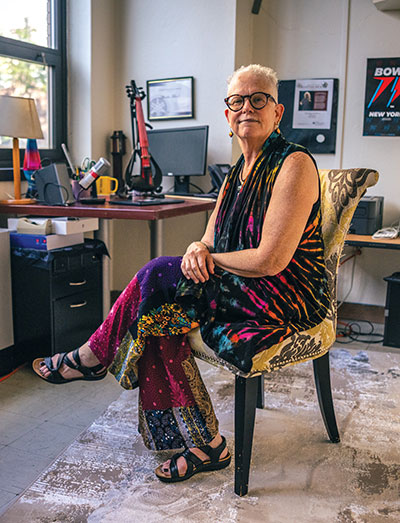
It was more than just four years of schooling, Mooke said of her time at UAlbany because “Nathan and his wife Polly became family.”
Now, more than 30 years later, she is the teacher and her students at New Jersey City University have become her family. Two of her graduate students, a couple who met through Mooke’s multi-style music program, moved into the same building as Mooke in Bayonne, New Jersey. They remain close. After decades of collaborating with monumental musicians, Mooke, when asked what her biggest accomplishment is, doesn’t skip a beat: her students.
“It’s a little mind-blowing,” Mooke says of her former students. One has just wrapped a gig playing solo violin with Foreigner in Las Vegas, another recently played on tour with Joe Jackson and one more is on tour with David Byrne, the Talking Heads frontman with whom Mooke played during a performance at the 2004 Tibet House. Listening to Mooke is like hearing a proud mom. Her students mean everything to her.
“My calling on this planet,” she says, “is to help people access their inner voice, their inner creativity.”
Nick Muscavage ’16 is a senior reporter at Financial Times and freelance journalist. Paul Miller MA ’21 is editor of this magazine.